
Handling Rent and Payment Questions With an AI Answering Service
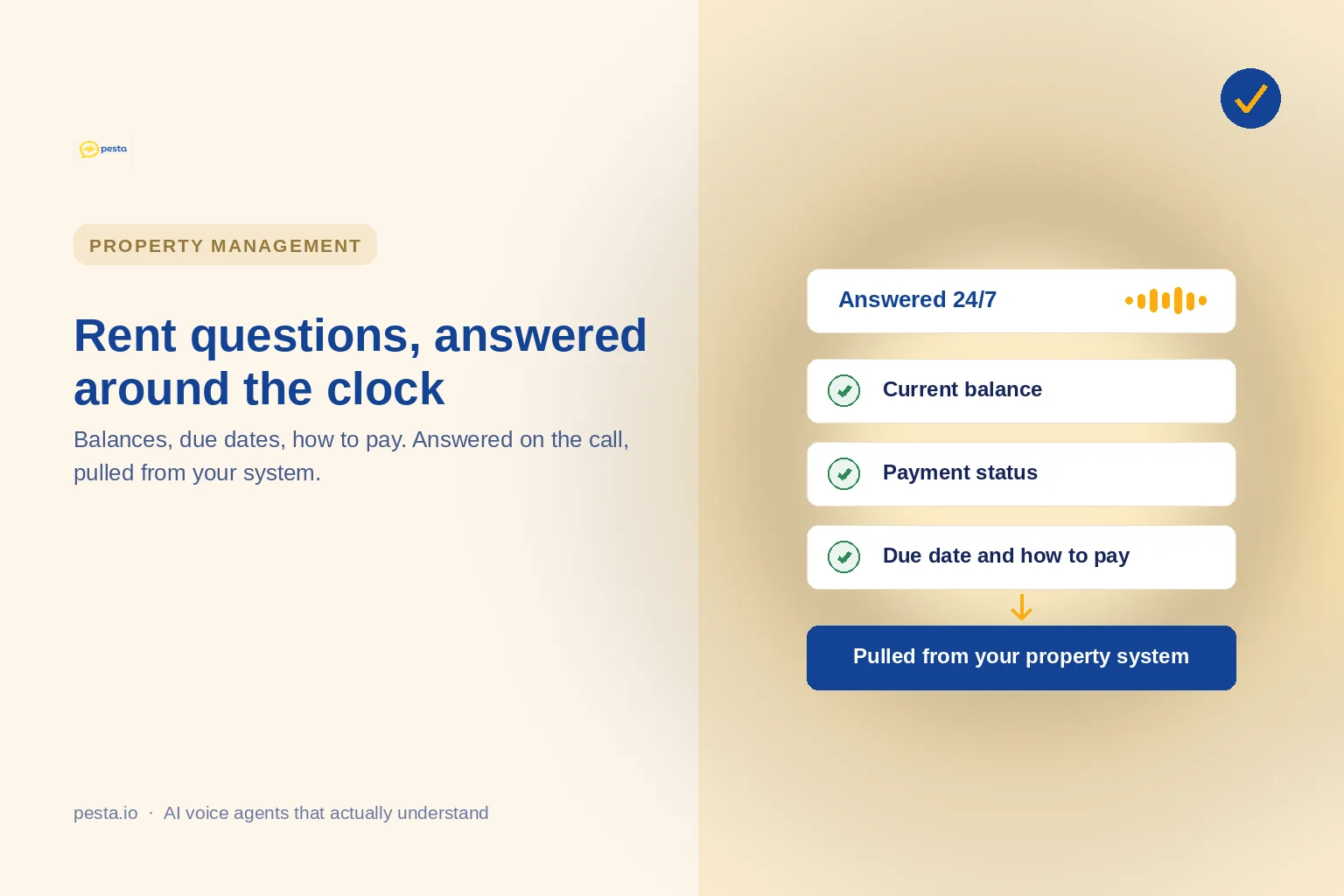
Rent and payment calls cluster around the due date, and most of them are routine: when is rent due, how do I pay, what is the late fee policy. An AI answering service like Pesta answers those from the rules you configure, in English and Spanish, around the clock. Anything account-specific is answered if your records are connected, or captured and routed with a summary if not. Disputes, hardship requests, and fee waivers always go to a person.
The first of the month is loud. Tenants call to ask when rent is due, how to pay it, whether their payment went through, and what happens if they are late. Most of those calls are quick, but there are a lot of them, and they land while your team is busy or already gone for the day. Handling rent and payment questions with an AI answering service takes that repetitive load off your staff, so a tenant gets an answer at 9 p.m. on a Sunday instead of a voicemail. Pesta is one of these agents, and this is a plain look at what it can answer, what it hands to your team, and how to set it up.
Why rent and payment calls pile up
Billing questions follow a calendar. They cluster around the due date, the end of the grace period, and the day late fees post, so your phones spike at the same times every month. Each call is simple on its own, but a stack of them buries a small team.
The stakes are not small either. The Consumer Financial Protection Bureau analyzed national rental payment data from September 2021 to November 2024 and found that the average late fee reached $85 in November 2024, and only about half of renters who fall behind catch up within a month. A tenant who cannot get a clear answer about what they owe or how to pay is more likely to miss the window, and a missed window turns into a fee, a dispute, and a longer conversation later.
The way tenants pay is also changing. Rentec Direct's ten-year data shows online rent payments grew from 4% of payments in 2014 to 51% in 2025. More portals and autopay settings mean more calls that start with "did it go through?" or "why did autopay fail?"
What renters expect when they call
Speed matters. In Buildium's 2026 renters report, which surveyed 1,500 U.S. renters, 84% expect a reply from their property manager within 24 hours, and 61% expect one the same day or sooner. The same report found that renters who are satisfied with communication are 58% more likely to plan to renew.
The report is just as clear about limits. About 60% of renters are open to self-service tools or chatbots for at least one part of the experience, but 40% prefer no automation at all, and renters still want a real person when a problem is urgent, complex, or sensitive. That is a good design rule for billing calls: automate the routine answer, and make the handoff to a person fast and clean.
What an AI answering service can answer about rent and payments
A capable agent answers the questions that have the same answer for every tenant, and hands off the ones that need judgment. Here is how the common calls break down.
The agent works as a 24-hour call answering service, speaks English and Spanish, and every call is transcribed and summarized, so your team has a record of what was said and what was promised.
How it handles a payment call, step by step
1. It finds out who is calling and what they need
The agent asks for what it needs, such as the unit and the tenant's name, so it is answering about the right account and not giving a general reply.
2. It answers from your rules
Due dates, grace periods, accepted methods, and how to use the resident portal come from the knowledge base you configure. This is where most calls end, because these answers do not change from tenant to tenant.
3. It uses your records where they are connected
Pesta connects through your CRM and Zapier, including Salesforce, HubSpot, Zoho, monday.com, and Calendly, so what a call captures reaches the tools your team already uses. Where the agent cannot read an account record, it says so, takes the details, and routes the question instead of guessing at a number.
4. It hands off what it should not decide
A dispute, a hardship request, or a fee waiver goes to your team with a summary attached, so the person who calls back already knows the story. The agent carries the routine load and leaves judgment calls to people. Callers often raise a repair in the same call, so it helps to automate maintenance requests the same way.
The gap in most answering services
A traditional answering service can read back your office hours and say rent is due on the first, because those are general facts. What it usually cannot do is answer a question about a specific account, and it often cannot answer policy questions in detail either, because it works from a short script. So the tenant waits for a callback, and your team makes it.
Pesta is an AI voice agent for property management that closes part of that gap. It answers the policy questions fully, at any hour, from your own rules, and writes up the account-specific ones so the callback is quick. That is the difference between taking a message about rent and actually handling the rent question. For the wider picture of call coverage, see how a property management answering service handles the whole queue.
What to set up before you turn it on
The agent is only as good as the rules you give it. Before launch, write down these seven items in plain language:
- Due date and grace period, exactly as they appear in your lease.
- Accepted payment methods and the steps to pay in your portal.
- Autopay steps, including what to do when a payment fails.
- Late fee policy as written in your leases. Late fee rules differ by state and by lease, so load your own, not a generic one.
- Who handles disputes and hardship requests, and how fast they call back.
- Office hours and the after-hours path for true emergencies.
- Spanish wording for the policies tenants ask about most.
If you also send reminders before the due date, the two work together. Our guide on how to cut late payments with AI rent reminders covers the outbound side, and this article covers what happens when the tenant calls back.
What this is worth: run your own numbers
Routine billing calls are easy to wave off because each one is short. Add them up and the picture changes. Enter your own volume below to see how many staff hours those calls take each month.
The math behind it: billing calls per day × days × share that are routine × minutes each ÷ 60 = staff hours you could hand off each month. Those hours go back to leasing, renewals, and the disputes that actually need a person. To see the revenue side of unanswered calls, read our guide to the ROI of an AI voice agent for property management and the breakdown of what a missed call costs in property management. If you want to see how fast tenants expect replies, our piece on how AI helps property managers respond to tenants faster goes further.
FAQ
[Q]Can an AI answering service tell a tenant their exact balance?[/Q]
[A]
It depends on how the agent is connected to your records. Pesta answers policy questions, like due dates, accepted payment methods, and grace periods, from the knowledge base you configure. Account-specific questions, like an exact balance, can be answered when the agent can read that record. When it cannot, it collects the unit and the question and routes it to your team with a summary, instead of guessing.
[/A]
[Q]What rent questions can an AI answering service handle without staff?[/Q]
[A]
The routine ones: when rent is due, what the grace period is, how and where to pay, which payment methods you accept, how autopay works, and what the late fee policy says. These have the same answer for every tenant, so the agent can answer them directly from your rules at any hour.
[/A]
[Q]What happens when a tenant disputes a charge or says they cannot pay?[/Q]
[A]
The agent does not decide. It collects the details, tells the caller who will follow up, and routes the case to your team with a call summary attached. Disputes, hardship requests, fee waivers, and anything legal stay with people.
[/A]
[Q]Does it answer rent questions in Spanish?[/Q]
[A]
Yes. Pesta supports English and Spanish callers, so a Spanish-speaking tenant can ask about a due date or how to pay in their own language.
[/A]
[Q]Will tenants accept an AI answering rent calls?[/Q]
[A]
Most renters are open to self-service for part of the experience, but they still want a person for urgent, complex, or sensitive issues. That is why the agent answers routine questions and hands everything else to your team. Buildium's 2026 renters report found 60% of renters are open to self-service tools or chatbots for at least one part of the experience, and 40% prefer no automation at all.
[/A]
[Q]Will my team see what the agent said?[/Q]
[A]
Yes. Every call is transcribed and summarized, so your team has a record of the question, the answer, and anything routed for follow-up.
[/A]