
Speed-to-Lead: Why Every Minute Costs You the Deal
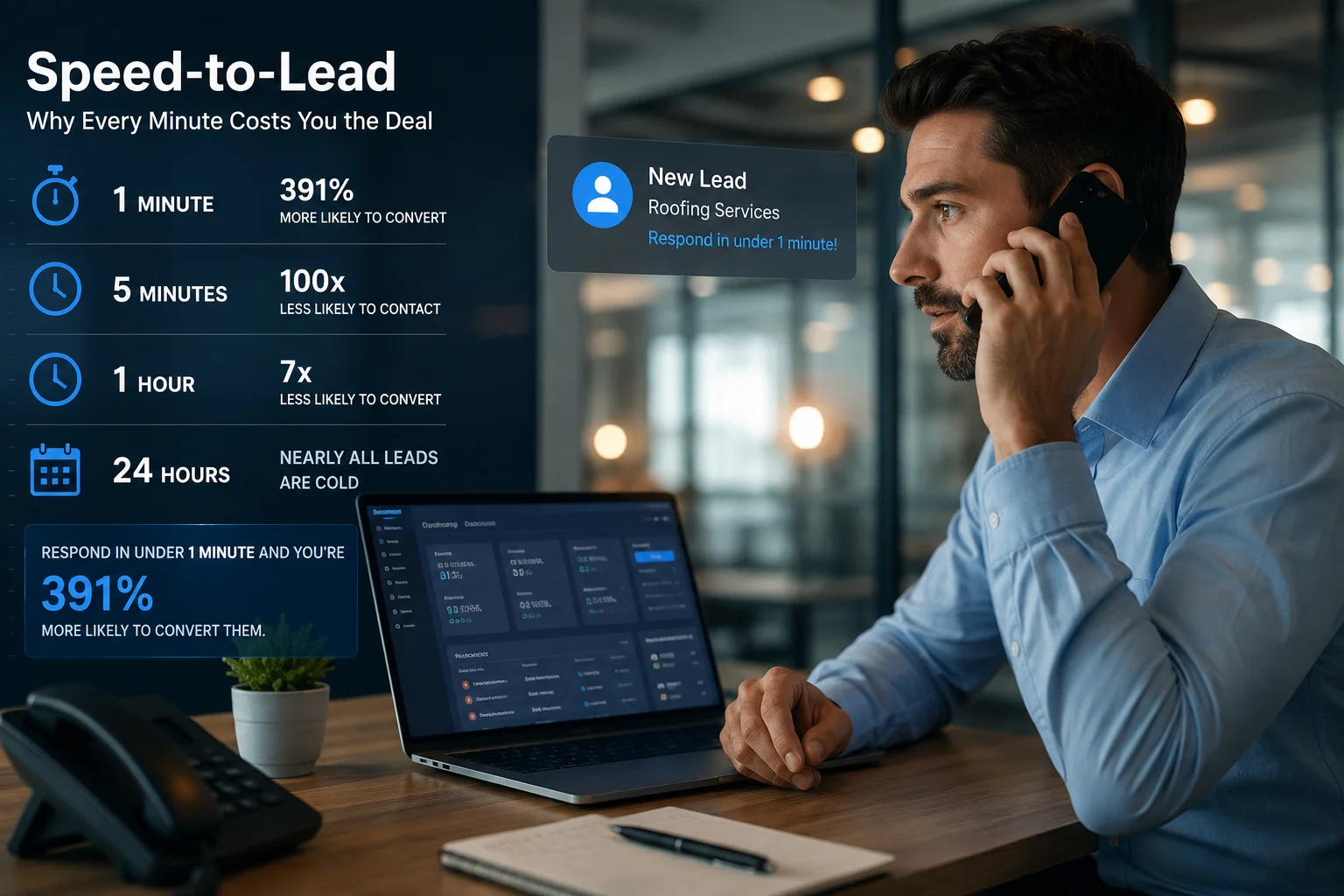
Respond to a lead in under 1 minute and you're 391% more likely to convert them. Wait 5 minutes and contact odds drop 100×. Wait an hour and most are gone. Wait 24 hours and the lead is cold.
92% of businesses lose qualified leads every month - not because of poor salespeople, but because humans can't answer every call instantly. Voice AI can. Every missed call is a calculable revenue loss. The only sustainable fix is a system that responds in seconds, every time, regardless of hour.
There is one number that should permanently change how your business handles inbound leads: 391%. That is the conversion rate advantage you gain by responding to a lead within one minute versus waiting even a few minutes longer. The research is not new, but the gap between what the data demands and what most businesses actually do has never been wider.
This article breaks down the speed-to-lead data, the psychology behind why leads decay so quickly, exactly how much revenue slow response is costing you, and how voice AI lead qualification closes that gap permanently.
What Is Speed-to-Lead and Why It's the #1 Sales Metric
The Definition in Plain English
Speed-to-lead is the time elapsed between a prospect expressing interest filling out a form, making a call, clicking a CTA, and your business making first contact. It is one of the most consequential customer acquisition metrics in sales, and one of the most neglected.
Lead generation has become a core investment for businesses across every industry. But generating the lead is only half the equation. What happens in the seconds and minutes after that lead arrives determines whether you convert or lose them.
Why Speed-to-Lead Became a Critical Customer Acquisition Metric
Modern buyers move fast. When someone searches for a service, requests a quote, or calls your business, they are in an active decision-making window. That window closes quickly and it often closes in favor of whoever responds first, not whoever is best.
Customer relationship management frameworks have long recognized first-touch speed as a conversion driver. But it took large-scale behavioral data to show just how extreme the drop-off is.
The Hidden Cost: How Much Revenue Are Missed Calls Actually Costing You?
42% of Businesses Miss Follow-Ups Several Times a Month
A 2026 Dropped Leads survey conducted by Zapier (via Centiment, April 2026) of more than 400 U.S. B2B sales and marketing managers found that 92% of managers say qualified leads slip every month and 42% of managers report their teams fail to make a second or third follow-up attempt.
The survey also found that 38% of managers said qualified leads are dropped multiple times a week, while 12% said it happens nearly every day. This is not an edge case. It is the default operating mode for most businesses.
How Many Hours Per Week Are Spent on Manual Lead Tasks?
The same Zapier survey found that 68% of managers reported their teams spend between three and ten hours per week on CRM upkeep alone - entering leads, updating deal stages, and fixing duplicate records - meaning some sales representatives spend as much as a quarter of a standard 40-hour work week on tasks not directly tied to selling.
That is time that is not being spent calling leads back. It is the structural reason why speed-to-lead fails at most organizations - not effort or intention, but system design.
Calculate How Much You're Losing to Slow Lead Response
Use this calculator to estimate the annual revenue impact of missed or delayed lead follow-up at your business. Enter your numbers into the formula below.
Every dollar in that calculator represents a lead that called your business, waited, and chose someone else. The math doesn't lie, and it compounds. Miss 100 leads a month at a 20% close rate and a $1,500 deal value, and you're not just losing $30,000 monthly. You're handing your competitors a funded pipeline.
The fix isn't hiring faster humans. Humans sleep, go on lunch, and have bad days. The fix is making sure every inbound call is answered, qualified, and followed up, in seconds, not minutes.
That's exactly what Pesta's AI voice agents do. Pesta picks up every call the moment it comes in, qualifies the lead through natural conversation, and books the appointment 24/7, with zero missed windows. No hold music. No voicemail. No lost revenue sitting in a calculator.
If the numbers above made you uncomfortable, that's the point. Request a demo and see how Pesta works and stop leaving money on the table.
What Happens to Your Lead After You Miss That Call
The 1-Minute Window: +391% Conversion Advantage
Research from Vendasta, supported by findings from Harvard Business Review and InsideSales.com, shows that responding to a lead within one minute increases conversion rates by up to 391% compared to slower follow-up. This is not a marginal gain - it is a structural competitive advantage that compounds across every lead your business receives.
The 5-Minute Mark: Still Salvageable, But Dropping Fast
The MIT Lead Response Management Study found that the odds of contacting a lead if called within 5 minutes versus 30 minutes drop 100 times, and the odds of qualifying that lead drop 21 times. Five minutes feels fast. In practice, for a business relying on human receptionists or a sales team juggling multiple tasks, it is almost impossible to hit consistently.
The 1-Hour Threshold: You've Lost Most of Them
The MIT/InsideSales.com data shows that the odds of contacting a lead decrease by over 10 times within the first hour, and the odds of qualifying that lead decrease by over 6 times within that same hour. By the time most businesses get around to calling back, the prospect has already spoken to a competitor or simply moved on.
After 24 Hours: The Lead Is Cold
Despite this data, the average business response time to a web lead is over 40 hours, and nearly half of businesses never respond at all. At 24 hours, the lead is statistically cold. The prospect has resolved their need elsewhere, mentally moved on, or simply forgotten they reached out.

Why Leads Go Cold So Fast: The Psychology of Intent Decay
A lead is not just a data point, it is a moment of intent. Intent is perishable. Understanding the psychology of what happens inside a prospect's mind at each interval helps explain why the data is so extreme.
What's Happening in the Prospect's Mind at Each Time Interval:
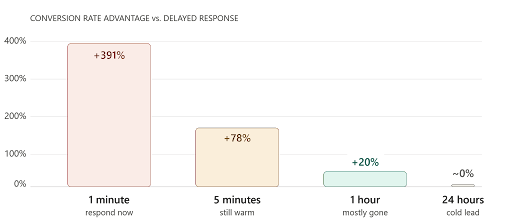
The moment a prospect fills out a form or dials your number, their brain is primed and in problem-solving mode. Every minute that passes without contact allows doubt, distraction, and competing solutions to erode that intent. Speed-to-lead is not about being pushy - it is about meeting the prospect exactly where their attention is.
What Is Voice AI Lead Qualification and How Conversational AI Works
Conversational AI for businesses operates as an always-available front-line agent that answers inbound calls, qualifies prospects using a defined question set, captures lead data, and routes or escalates based on predefined logic - all within seconds of a call arriving.
Unlike a form autoresponder or a callback bot, a well-configured voice AI engages the prospect in natural dialogue, gathers the information your sales team needs, and delivers a warm, qualified lead - whether the call comes in at 2pm on a Tuesday or 11pm on a Sunday.
To understand how this technology works at a deeper level, read our article on what an AI voice agent is and why your business needs one.
How AI Agents Improve Speed-to-Lead for Local Businesses
For local and regional service businesses, where calls are the primary lead channel and staff are often occupied on jobs, a voice AI agent closes the single biggest gap in the sales funnel: the unanswered call.
Velocify research reinforces that rapid initial response and strategic follow-up are the primary drivers of sales effectiveness, far outweighing factors like time of day. Voice AI makes rapid response the default, not the exception.
How to Measure the Success of Automated Lead Qualification Processes
The 5 KPIs That Actually Matter
Implementing lead nurturing automation is only valuable if you measure it correctly. Most businesses track vanity metrics. These five KPIs connect directly to revenue.
How to Improve Your Lead Qualification Process in 5 Steps
Lead Nurturing Automation: What Happens After the First Call
The first contact is critical, but the follow-up sequence is what actually closes deals. Most leads require multiple touchpoints before committing, and lead nurturing automation ensures no prospect falls through the cracks after the initial call.
The Follow-Up Sequence That Keeps Leads Warm
According to Zapier's 2026 research, the dropped-lead problem is rarely a missing tool - it is a missing handoff. When a lead arrives, the record should be created, the rep notified, and the follow-up sequence triggered automatically. Voice AI handles the handoff at every step.
Speed-to-Lead by Industry: Where the Biggest Gaps (and Wins) Are
Home services, legal, and real estate businesses face the highest cost of delay because their leads arrive with an immediate, urgent need. These are precisely the industries where voice AI lead qualification delivers the fastest and most measurable ROI.
FAQ
[Q]Does speed-to-lead matter for B2B, or just B2C?[/Q]
[A]
It matters for both, but the dynamics differ. B2C intent windows are shorter and more emotional. B2B prospects are often evaluating multiple vendors simultaneously, and the first vendor to engage often shapes the evaluation criteria for everyone else.
[/A]
[Q]What counts as "contact" does a voicemail or automated email qualify?[/Q]
[A]
No. The MIT study defines contact as a live conversation. A voicemail or auto-reply email does not reset the clock on intent decay. The prospect is still waiting for a real response.
[/A]
[Q]Should I prioritize speed-to-lead over lead quality scoring?[/Q]
[A]
Speed and quality are not in competition they operate in sequence. Respond fast first, qualify second. Slowing down response to pre-score leads destroys conversion rates. Qualification happens during the first conversation, not before it.
[/A]
[Q]How many follow-up attempts should a business make before marking a lead as lost?[/Q]
[A]
Research from InsideSales.com Lead Response Management suggests six attempts as the optimal number most businesses stop at one or two. After six attempts across multiple channels and time windows, diminishing returns set in sharply.
[/A]
[Q]Does industry or geography affect how quickly leads expect a response?[/Q]
[A]
Yes. High-urgency industries (legal, medical, home services) and densely competitive markets have the shortest tolerable wait times often under two minutes before a prospect moves on. Lower-urgency B2B categories may have a slightly wider window, but the data consistently rewards speed regardless of vertical.
[/A]
[Q]What happens to speed-to-lead during after-hours and weekends?[/Q]
[A]
That is where the gap is largest and the competitive advantage is greatest. Most businesses are completely dark outside of 9–5. A prospect who calls at 7pm on a Friday and gets an immediate, intelligent response is almost certain to convert because no competitor is answering either.
[/A]
[Q]Is there a point of diminishing returns can you respond "too fast"?[/Q]
[A]
The data shows no evidence of a response being too fast. What matters is that the first response feels human and relevant, not robotic and generic. A voice AI agent that immediately engages the prospect with a relevant question outperforms both a missed call and a canned auto-reply at any speed.
[/A]