
After-Hours Maintenance Requests: The Cost of Unanswered Calls
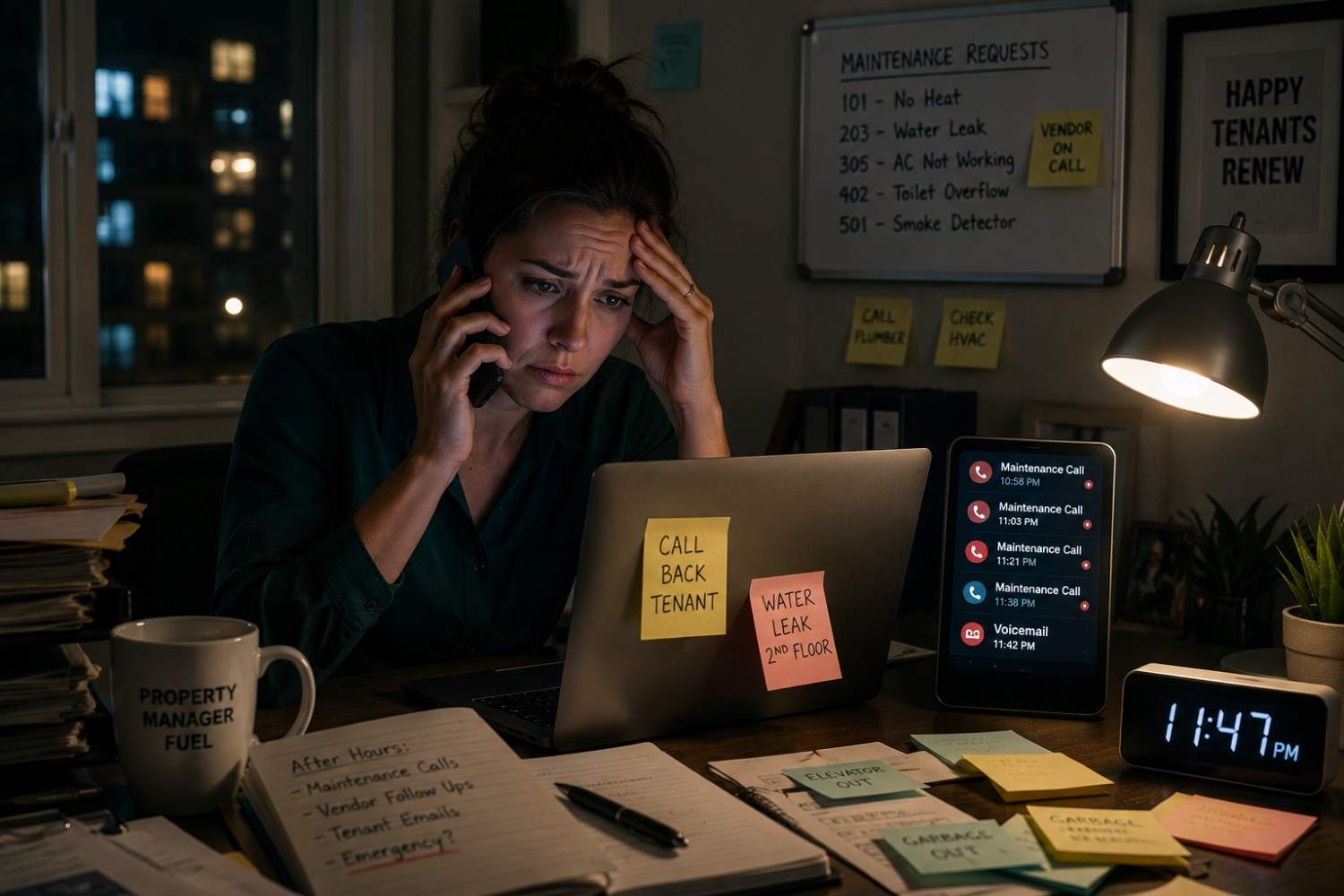
Unanswered after-hours maintenance calls cost more than a missed repair, they cost renewals. Data shows only ~10% of calls are true emergencies, but that small share needs a response within 1 hour or the damage (and the tenant relationship) compounds fast: emergency repairs run 3-5x more than preventive fixes, and slow response is a top driver of non-renewal. A 24/7 AI voice agent closes that gap by triaging every call instantly, day or night.
It's 11:40 PM. A tenant's water heater just died, or worse, a pipe is spraying water across the kitchen floor. They call the property management office. It rings. Then it goes to voicemail.
What happens in the next ten minutes decides more than whether that one repair gets fixed by morning. It decides whether that tenant renews their lease next year, whether they leave a review, and whether the water damage bill lands on your desk at ten times the cost it would have been at 11:45 PM instead of 7:00 AM.
This is the after-hours problem, and the data on it is not subtle. Here's what the numbers actually say about what an unanswered call costs a property management business, and what a 24/7 on-call maintenance system changes about that math.
What Counts as a "Maintenance Request," and Why After Hours Is Different
A maintenance request is any formal notice a tenant submits asking a property manager or landlord to inspect, repair, or replace something in their unit or the shared property. Most are routine: a sticking cabinet hinge, a flickering light. Some are urgent. A small number are true emergencies, the kind where every hour of delay compounds the damage.
During business hours, this is manageable. A team member picks up, logs the issue, dispatches a vendor. After hours, the system that works from 9 to 5 usually collapses into voicemail, and voicemail is where maintenance requests go to die.
What Share of Maintenance Calls Are Actually Emergencies?
Not every after-hours call needs a truck rolling out at midnight, and that matters for how you build a response system. Industry practice sorts requests into three or four urgency tiers, and only the top tier, true emergencies like burst pipes, gas leaks, no heat in freezing weather, or active flooding, needs an immediate on-site response. Urgent issues, like a failed water heater or a major plumbing backup, are serious but not immediately dangerous. Routine issues, the leaky faucet or the broken hinge, are important but can wait until morning without anyone's home flooding.
The U.S. government's own operations benchmark backs this up from the other direction: well-run maintenance operations keep emergency work under 10% of total maintenance hours. In other words, the overwhelming majority of after-hours calls aren't five-alarm fires. But property managers rarely know that in the moment, because most phone systems can't tell an emergency from a routine request until a human, or an AI trained to triage, actually listens to what's being said. That's the real cost of a voicemail system: it treats every unanswered call as equally invisible, when in reality most calls need a fast acknowledgment and a smart minority need someone dispatched immediately.
What Is the Average Maintenance Response Time, and What Should It Be?
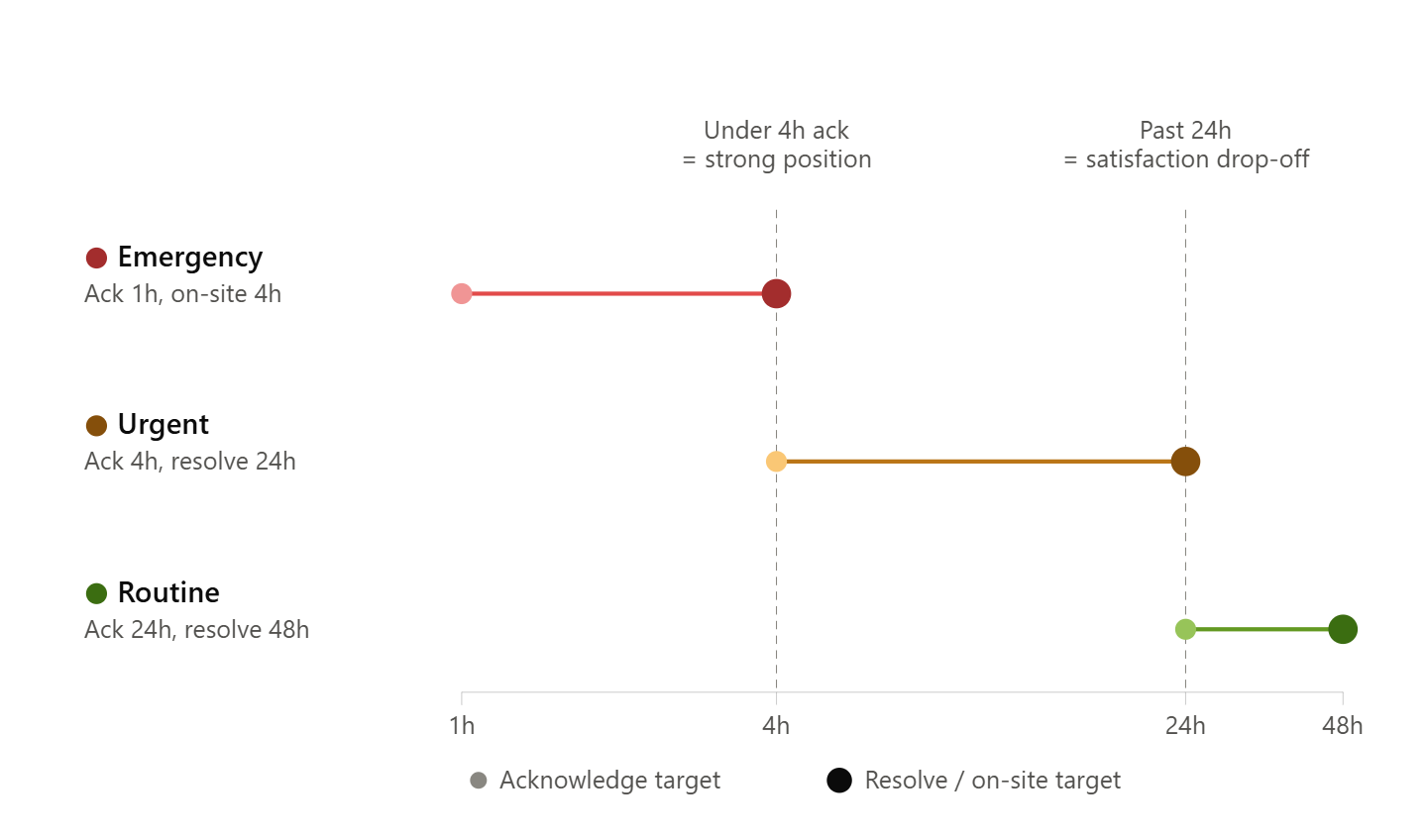
There's a widely used benchmark here, and it's tighter than most property managers assume. Best practice sets response windows by urgency: emergencies should be acknowledged within one hour and get eyes on-site within four hours, with full resolution inside 24 hours. Urgent issues like HVAC failures should be resolved within 24 to 48 hours. Routine requests should be acknowledged within 24 hours and resolved within 48 hours.
That 24-hour acknowledgment window is the line in the sand. Miss it consistently, and it stops being a service gap and starts being a lease-renewal risk. Buildium's research points to a similar standard from the property management side: teams that respond to regular issues in under four hours are in a strong position, under 24 hours is acceptable, and once response time creeps past 24 hours, resident satisfaction drops noticeably and the odds of additional property damage climb.
Here's the uncomfortable part: none of these clocks pause at 6 PM. A pipe doesn't check the office hours before it bursts, and a benchmark built around "acknowledge within one hour" assumes someone is actually there to acknowledge it, at 2 AM as much as 2 PM.
The After-Hours Math: How Many Calls Are Emergencies vs. How Fast They Need to Be Answered
Lay the two benchmarks above side by side and the scale of the after-hours gap becomes obvious. On one side, the volume: under 10% of total maintenance work qualifies as a true emergency. On the other side, the clock: that small slice of emergencies is exactly the one required to be acknowledged within one hour and reached on-site within four, no matter what time it comes in.
The mismatch is the whole problem in one sentence: the smallest slice of calls carries the tightest deadline, and that deadline runs on a clock that doesn't care whether your office is staffed. A one-hour acknowledgment window started at 11:40 PM is over by 12:40 AM, whether or not anyone was there to hear the phone ring. Treating after-hours coverage as optional means the acknowledgment window gets missed on exactly the calls where missing it costs the most — the roughly 1-in-10 that are genuine emergencies, arriving on a clock that runs 24 hours whether or not the office does.
How Not to Miss an Emergency Request
The framework that works, whether it's executed by a live team or an automated system, follows the same four steps every time:
- Acknowledge instantly. The tenant needs to know their message was received within seconds, not hours. Buildium's research found that an automated confirmation sent within moments resolves the majority of "I never heard back" complaints before they even happen.
- Triage by keyword and context. Is there standing water? Is the smell of gas involved? Is there no heat and it's below freezing? A few targeted questions separate a real emergency from a request that can wait until morning, and that triage step alone saves hours of wasted dispatch time.
- Dispatch based on severity. True emergencies route to an on-call vendor immediately. Everything else gets scheduled for the next business day, with a clear, proactive update sent to the tenant so they're not left wondering.
- Document everything. A timestamped record of when the call came in, what was said, and what action was taken protects the property manager just as much as it reassures the tenant.
The organizations executing this well have stopped treating "handle an emergency call" as a matter of luck, whoever happens to be near the phone, and started treating it as a system with defined rules.
The Real, Compounding Cost of an Unanswered Call
This is where the numbers get uncomfortable. An analysis of call data across service businesses found that home service companies miss 62% of their inbound calls, and the response-time data tied to those missed calls should worry any operator managing tenant relationships. Callers who wait even 30 minutes for a callback have moved on to another option by the time someone calls them back; wait an hour or more and the vast majority have already found help elsewhere.
Now translate that into property management terms. A tenant who calls after hours and hits voicemail doesn't have "another option" the way a lead shopping for a plumber does, but they do have options: they escalate, they complain publicly, they remember it at renewal time. An analysis of negative reviews for service businesses found that the single most common complaint, appearing in 37% of one-star reviews, was some version of "called multiple times, never got an answer." That's not a maintenance failure. That's a communication failure, and it's the one that shows up publicly, in the reviews that future prospects read before they ever sign a lease.
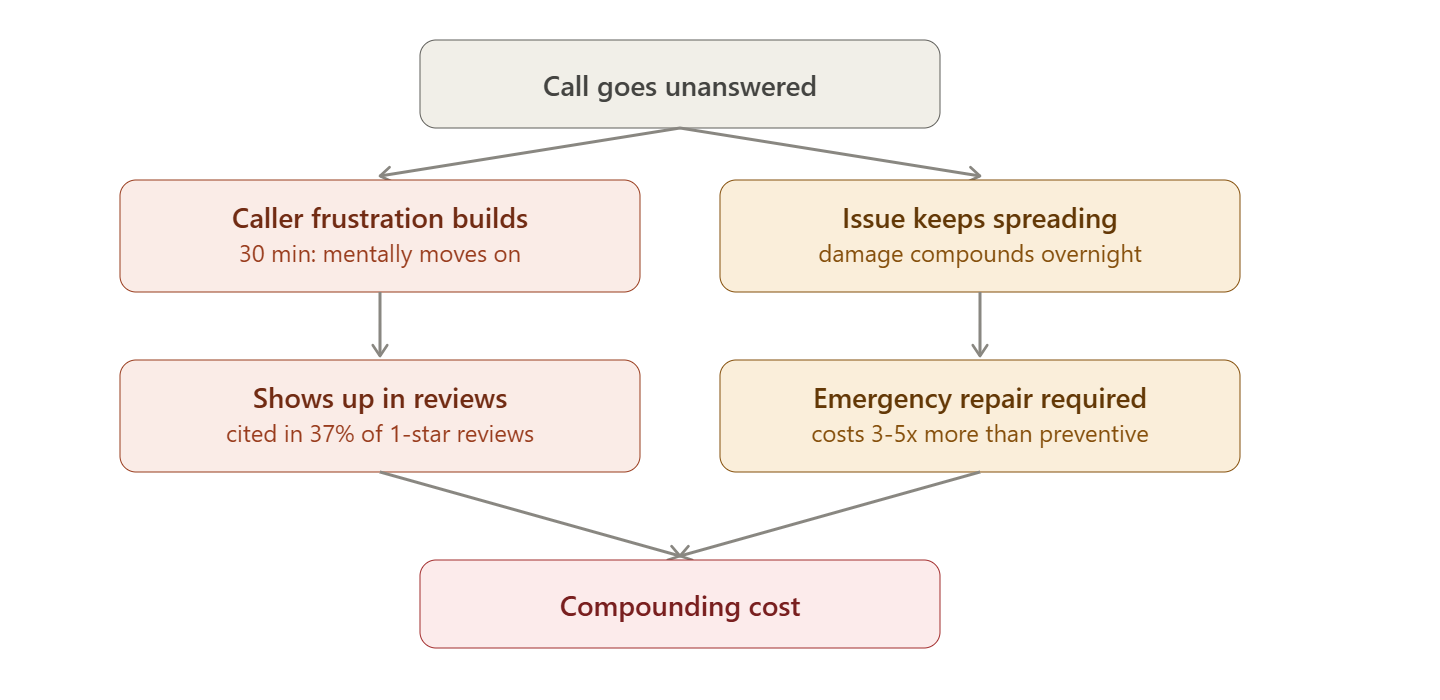
There's a financial multiplier hiding underneath the emotional cost, too. Deferred or delayed maintenance doesn't just annoy tenants, it gets more expensive the longer it waits. Emergency or breakdown maintenance, the kind that happens when a small issue is ignored until it becomes an after-hours crisis, typically costs three to five times more than the equivalent preventive repair would have. A missed after-hours call about a slow leak doesn't stay a slow leak. By the time someone calls it back the next morning, it may be a subfloor replacement.
What Unanswered Calls Actually Cost You in Renewals
Here's the connection property managers can't afford to miss: maintenance response speed isn't just an operations metric, it's a retention metric, arguably the most important one available.
Renters make this explicit when asked directly. Among renters still undecided about renewing, 31% say a property manager being more responsive to maintenance requests would likely convince them to stay, and 40% cite more investment in maintaining the property overall. Renters overwhelmingly rank the speed of a property manager's response as a major factor even before they've signed a lease: 92% say the speed of response influences their choice of where to live, nearly matching the influence of the unit's actual amenities. And when renters were asked what causes the most stress in their entire rental experience, waiting for a maintenance issue to get resolved ranked as the second-biggest source of stress they reported, trailing only the initial search for a rental itself.
That stress translates directly into turnover. Streamlining maintenance communication and response has been shown to cut tenant turnover by up to 25% within six months of implementation. That's a meaningful number once you know what turnover actually costs: the National Apartment Association reports average turn costs between $1,500 and $3,500 per unit, with a fifth of operators reporting even higher figures, and on a mid-sized portfolio, a modest five-point lift in retention can translate into tens of thousands of dollars in avoided turnover costs in a single year. Maintenance troubles, on top of that, are consistently cited as one of the top drivers behind a tenant's decision to leave in the first place, right alongside inadequate communication.
Put those two data points together and the after-hours voicemail box isn't a minor inconvenience. It's sitting directly on top of the biggest controllable lever property managers have over their renewal rate.
But turnover is the cost you see months later, buried in a P&L line item. There's a second cost sitting closer to the surface, on every pay period: what it actually takes to staff a phone for the hours nobody wants to work. Rotating on-call schedules, overtime pay, and after-hours stipends add up fast once you multiply them across a portfolio, and most operators have never actually run the math on what that coverage costs per unit, per month.
Calculate Your Own Exposure: The Cost of Missed Maintenance Calls
Enter your portfolio size and your typical emergency call rate below to see roughly what your team is currently paying in overtime to staff after-hours maintenance calls, and what that adds up to over a year.
That number is the visible cost. The renter data above is the invisible one, showing up later as a non-renewal instead of a line item. Together, they're the same argument from two different directions: the phone you're not answering after hours is costing you whether or not anyone ever complains about it.
What a 24/7 On-Call Maintenance System With AI Actually Solves
This is the gap purpose-built maintenance dispatch software closes, and it's why property management automation has moved from "nice to have" to standard infrastructure for operators managing more than a handful of doors.
An AI voice agent built for property management answers every after-hours call on the first ring, no exceptions, no voicemail. It doesn't just record a message; it has the conversation. It asks the same triage questions a well-trained coordinator would: Is there water actively flowing? Is there a smell of gas? Is the heat out and is it below freezing outside? Based on the answers, it makes the same routing decision a human dispatcher would make in seconds: escalate to an on-call vendor immediately for a genuine emergency, or schedule the routine request for the next business day with a clear, proactive confirmation sent to the tenant.
That's the practical shape of AI maintenance dispatch: not a chatbot that deflects tenants, but a system that captures every call, applies consistent triage logic every single time regardless of the hour, and creates a timestamped record of exactly what was reported and when. It's the same logic property managers already apply to leasing and rent collection, applied to the one workflow that's historically been the hardest to staff around the clock.
FAQ
[Q]What happens if my team misses a genuine emergency call at 2 AM?[/Q]
[A]
The physical cost compounds fast, since emergency repairs typically run three to five times more than the same job handled preventively. It also becomes a story: unanswered emergency calls are a recurring theme in the negative reviews future tenants read before signing.
[/A]
[Q]Do renters expect a human to answer after hours, or is an AI voice agent acceptable?[/Q]
[A]
Renters care more about speed than who answers. Consumers broadly expect an "immediate" response, and a well-built AI voice agent that triages and confirms next steps in real time beats a voicemail box that calls back at 9 AM.
[/A]
[Q]Is 24/7 coverage worth it for a smaller portfolio, say under 50 units?[/Q]
[A]
Scale changes volume, not risk. Even with emergency work under roughly 10% of total maintenance hours, a 50-unit portfolio still sees real emergencies most months, and small operators are the least likely to have dedicated on-call staff.
[/A]
[Q]What's the difference between a live answering service and AI maintenance dispatch?[/Q]
[A]
A generic answering service takes a message but usually can't tell a dripping faucet from a burst pipe. AI maintenance dispatch asks the same triage questions a coordinator would and routes based on severity, not staffing luck.
[/A]
[QHow do we know if our after-hours process is actually failing tenants?[/Q]
[A]
Check three things: how many after-hours calls hit voicemail instead of getting answered live, how long acknowledgment actually takes once logged, and whether "never got a callback" shows up in reviews or renewal surveys.
[/A]
[Q]What should we look for in an AI maintenance dispatch solution?[/Q]
[A]
Real triage logic that distinguishes emergency, urgent, and routine requests, not just call answering. Also confirm it keeps a timestamped record of every call and still escalates genuine emergencies to a human.
[/A]