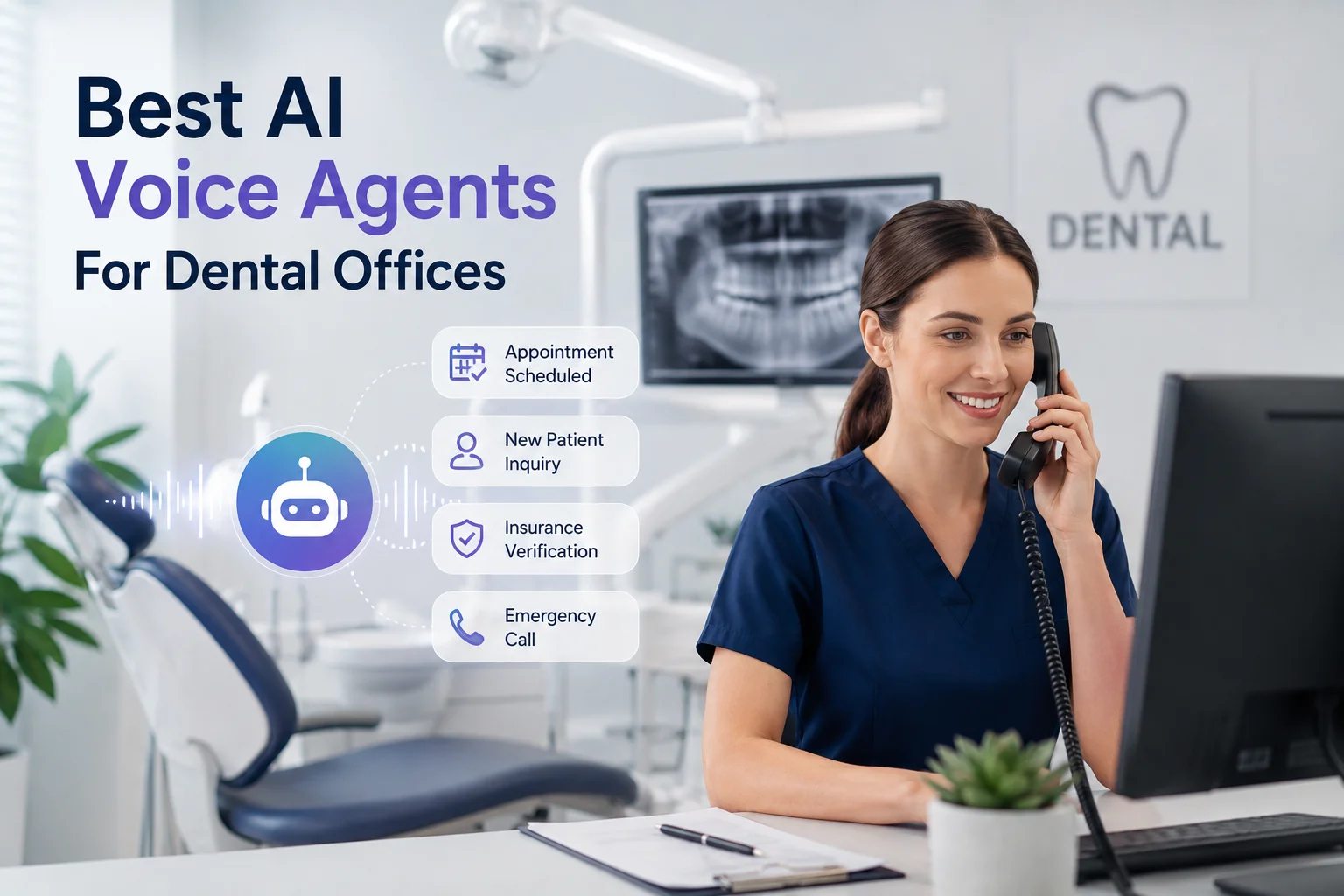
Best AI Voice Agents For Dental Offices
Pesta comes out ahead for dental practices and DSOs wanting full call coverage, natural conversation, and easy PMS integration, without the narrower scope of TrueLark, Arini, Weave, or CloudTalk.
It's 4:52pm on a Friday and the front desk phone won't stop ringing. A patient in pain wants an emergency slot, a parent is trying to confirm their kid's cleaning for Monday, and someone new to the area is calling three practices at once to see who picks up first. The front desk can only be on one call at a time, and every ring that goes to voicemail is a patient who might just call the next practice on the list instead.
This is the exact gap an ai voice agent for healthcare is built to close. Instead of sending overflow calls to voicemail or asking patients to call back, it answers immediately, understands what the patient needs, and either handles it or hands it off with the full context already captured. For a growing dental practice or DSO managing multiple locations, that consistency across every call is what keeps a full schedule full.
We put together this comparison to help dental practices and DSOs evaluate their options. It covers five platforms, what each one actually does well, and where the real trade-offs are.
What to Look For When Choosing an AI Voice Agent
A lot of tools marketed as AI receptionist software for dental offices are really general-purpose call bots with a dental label added on. Before comparing specific platforms, it helps to know what actually separates a purpose-built option from a generic one.
The 5 Best AI Voice Agents for Dental Offices
1. Pesta: Best Overall
Pesta is an AI voice agent that answers inbound calls, understands what a patient needs, and books, reschedules, or routes them in real time, all through natural, low-latency conversation rather than the clipped, robotic delivery that gives older phone bots away. It's the official US reseller of Deepdub's voice AI technology, which lets it hold natural conversations across a wide range of languages, so English and Spanish-speaking patients get the same responsive experience on the same line.
What sets Pesta apart for dental practices specifically is BASA, its self-improving knowledge base. Instead of following a fixed script, the agent pulls from a knowledge base that gets sharper with every call, so it can handle the specific questions a script always misses (a patient asking whether their insurance covers a certain procedure, a caller asking about same-day emergency availability). That flexibility is what makes it hold up as a virtual dental receptionist rather than a glorified voicemail box with better manners.
That combination, natural conversation, a knowledge base that keeps learning, and visibility into what's actually happening on calls, is built to complement a front desk team rather than replace it. Powered by Deepdub.
Best for: dental practices and DSOs that want one platform covering scheduling, emergency triage, and general patient questions without being locked into a single, narrow vendor ecosystem.
2. TrueLark
TrueLark is one of the more established names in this category, with a long track record handling scheduling calls for dental and other appointment-based businesses. Its strength is capturing missed calls and booking appointments across voice, text, and web chat, with automated follow-up built in.
The trade-off is specialization. TrueLark serves a wide range of appointment-based businesses beyond dentistry, salons, spas, and other service businesses among them, so its dental-specific depth (clinical terminology, insurance nuance, PMS-specific workflows) isn't always as tight as a platform built dentistry-first.
3. Arini
Arini is a Y Combinator-backed AI voice agent built specifically for dental scheduling. It focuses narrowly on one job: answering patient calls and booking appointments with natural-sounding conversation, and it's known for being fast to set up.
That focus is also its limitation. Arini is built around call answering and booking, so practices looking for a single platform that also covers text, web chat, and broader patient communication will likely need to pair it with additional tools rather than getting everything from one vendor.
4. Weave
Weave is not purely an AI voice agent, it's a broader communication platform for dental and other healthcare practices that includes VoIP phone service, two-way texting, patient reviews, and payments, with AI features layered on top.
For practices that want to consolidate their entire phone and communication stack into one vendor, that breadth is appealing. The trade-off is that Weave's AI calling capabilities are one part of a much larger platform rather than the core product, so if reliable, natural-sounding call handling is the main priority, it's worth evaluating that piece specifically rather than assuming it matches a voice-first platform's depth.
5. CloudTalk
CloudTalk is a well-known VoIP and call center platform that has built out a dental-specific virtual receptionist offering, combining AI call handling with deep CRM and practice management integration.
It's a reasonable option for practices that already use or are considering CloudTalk's broader call infrastructure. Outside of that context, it represents a bigger platform commitment, call center software with dental features added, rather than a purpose-built dental voice agent, which is worth keeping in mind if all you need is reliable phone coverage.
Dental Clinic AI Voice Agents Comparison
How to Use AI in Dental Office Operations
In practice, using an AI voice agent in a dental office comes down to plugging it into the calls that already take up the most front-desk time: scheduling, rescheduling, and answering the same handful of questions on repeat. The agent sits in front of these calls, handles what it can directly, and passes along anything that needs a person, with the details already captured.
What It Costs to Skip an AI Receptionist
Before deciding whether an AI voice agent is worth adding, it helps to see clearly what's already being lost without one. Most of that loss doesn't show up as a single number on a report, it's spread across missed calls, patients who call the next practice instead, and front-desk staff stretched across scheduling, insurance questions, and in-office check-ins at the same time.
Missed calls during business hours - Front desk can only handle one call at a time, so overflow calls go to voicemail while patients call elsewhere
After-hours and lunch coverage gaps - Calls during closed hours or staff breaks go unanswered unless a paid answering service covers them
Staff time on repetitive questions - Hours spent each week on hours, insurance, and scheduling questions instead of patients already in the chair
Missed emergency calls - A patient in pain who can't get through is more likely to book with whichever practice answers first
No-shows and gaps in the schedule - Without consistent reminder and recall calls, cancellations and no-shows go unfilled
Once you see where it's actually going, the value of closing those gaps with consistent call coverage becomes a lot easier to judge.
HIPAA & Patient Privacy
Any AI system handling patient calls for a dental office is handling protected health information, and that doesn't change because a computer is answering instead of a person. The same expectations around privacy and appropriate handling of patient data still apply.
A few things worth asking any vendor before rolling out AI on patient-facing calls:
This is genuinely one of the more important considerations in the category, and it's a good idea to have your compliance lead or practice manager review any vendor's approach directly rather than relying on marketing claims alone.
What Rollout Looks Like
How long it takes to implement an AI voice agent in a dental office depends mostly on two things: how deeply it needs to integrate with your practice management software, and how much the knowledge base needs to be tailored to your specific services, providers, and policies. A single-location practice with a standard PMS integration moves faster than a multi-location DSO running several different systems.
On the value side, most practices find it useful to track a few numbers for a few weeks before rollout, missed calls, after-hours coverage cost, and staff time on repetitive calls, so there's a real baseline to compare against afterward.
FAQ
[Q]How do I implement an AI voice agent for dental appointment reminders?[/Q]
[A]
Most platforms connect directly to your practice management software, so reminder calls or messages pull appointment details automatically and reach patients without a staff member placing outbound calls.
[/A]
[Q]Is there an AI agent for dental appointment scheduling?[/Q]
[A]
Yes. A well-built AI voice agent can book, reschedule, and confirm appointments directly during the call, syncing the booking straight into your PMS.
[/A]
[Q]What's a good AI patient scheduling software?[/Q]
[A]
Look for one that integrates natively with your practice management system, handles the languages your patients speak, and covers more than just scheduling, insurance questions and general inquiries included.
[/A]
[Q]What does an AI receptionist for dental offices actually do?[/Q]
[A]
It answers incoming patient calls, books and manages appointments, answers common questions, and routes anything that needs a person, functioning as a full virtual dental receptionist rather than just a voicemail replacement.
[/A]
[Q]What's the difference between a dental answering service and an AI voice agent?[/Q]
[A]
A traditional answering service routes calls to a live operator reading from a script. An AI voice agent answers directly, holds a natural conversation, and can book appointments and answer specific questions without a human relay in the middle.
[/A]
[Q]Do I need a separate after-hours answering service for my dental practice?[/Q]
[A]
Not necessarily. A capable AI voice agent can cover after-hours and lunch-break calls itself, which removes the need to pay separately for a third-party answering service.
[/A]
[Q]What's the best dental AI software for a growing practice or DSO?[/Q]
[A]
The strongest options combine natural conversation, PMS integration, and coverage across scheduling, triage, and general questions, without requiring a full platform switch to adopt.
[/A]