
Best Virtual Receptionist Services
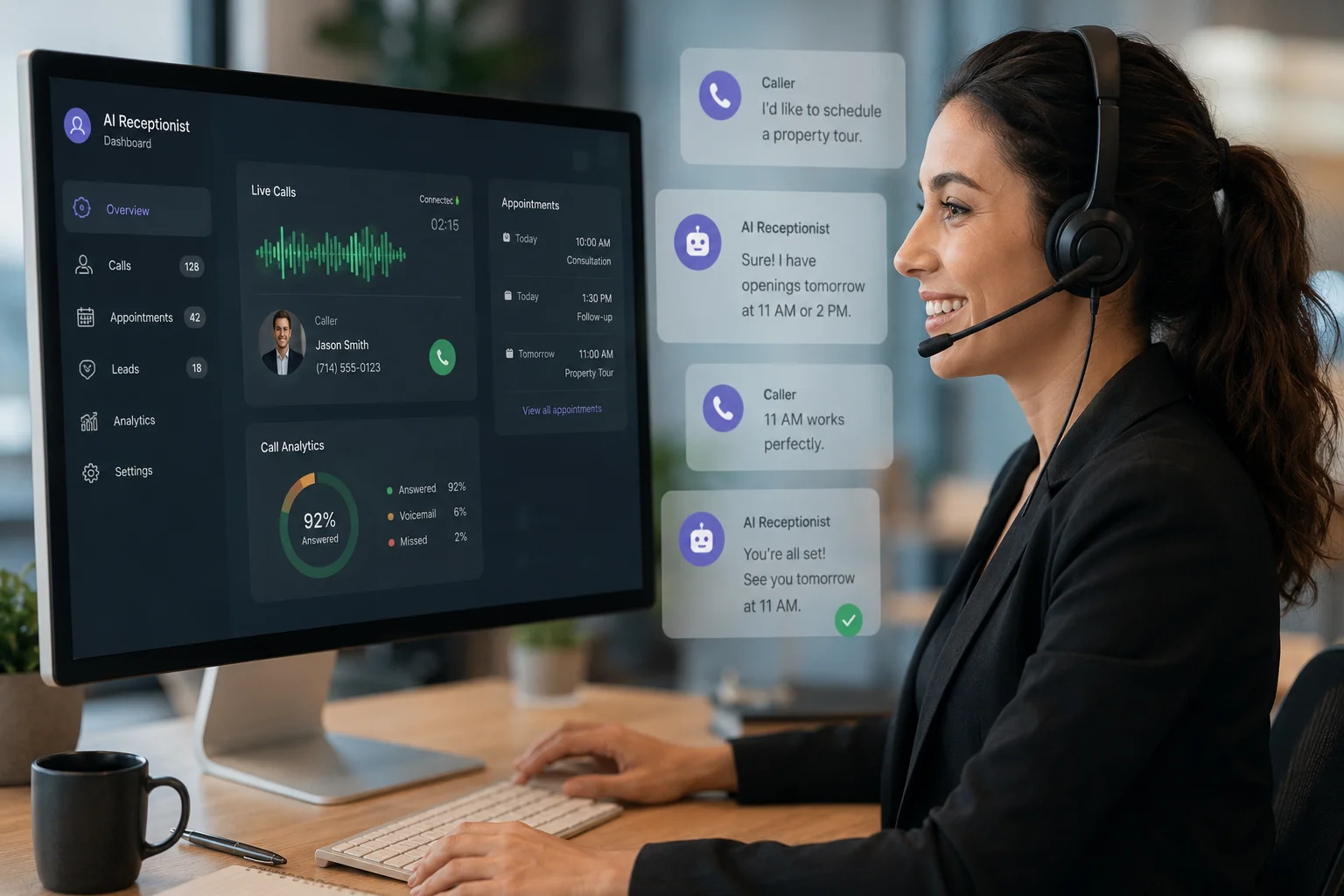
Growing companies need a virtual receptionist that qualifies leads, books appointments, and covers calls 24/7 without costs spiking as volume grows. AI-native options like Pesta scale predictably and can answer off-script questions; human and hybrid services (Ruby, AnswerConnect, Smith.ai) offer a live voice but get pricier at higher volume.
A virtual receptionist has one job at its core: pick up every call, figure out what the caller needs, and either resolve it or route it to the right person, without making the caller feel like they've been handed off to a machine. For a growing company, that means answering during business hours and after them, qualifying leads instead of just taking a message, booking appointments directly into your calendar, and giving your team a clean record of what was said on the call.
The gap between a basic answering service and a real virtual receptionist shows up fast once a company starts scaling. Call volume climbs faster than headcount, and every unanswered or poorly handled call is a customer decision happening without you in the room.
This is where AI changes the math. Instead of hiring, training, and scheduling more front-desk staff, a virtual receptionist services platform can answer every call around the clock, ask the right qualifying questions, book the appointment, and sync the outcome to your CRM or property management software. Below, we break down the best AI virtual receptionist companies for growing companies, what each one does well, what it costs, and how to think through the decision.
Pesta
Pesta is built specifically for mid-market and enterprise operations, property management portfolios, medical and dental groups, and home services companies, that have outgrown what a basic answering service can handle. Every call is answered by an AI voice agent that qualifies the caller, checks availability, books the appointment directly, and syncs the outcome to your CRM or property management platform.
The part that sets Pesta apart from most of the field is BASA. Most virtual receptionist tools, AI or human, run on a fixed script. Ask something outside the script and you get a transfer, a message, or a wrong answer. BASA gives dynamic answers instead of forcing every caller down the same rigid path.
That matters most for the exact pain points growing companies run into. A caller with a video-related issue can be walked through it live, with the AI voice agent asking them to turn on their camera to help diagnose the problem in real time. After the call ends, call analysis reviews why and when calls dropped off, so the system improves instead of quietly repeating the same mistake.
Smith.ai
Smith.ai runs two products side by side: a pure AI receptionist and a hybrid human-plus-AI virtual receptionist, and lets you route calls between them based on complexity. Smith.ai is a strong fit for law firms and professional services businesses where a caller describing a sensitive situation benefits from a live agent who can read the tone of the conversation. The tradeoff is cost predictability. Because pricing is per call rather than flat rate, a busy month can push the bill well above the base plan, and the hybrid model means you're paying human-agent rates for calls that a fully AI-native system could resolve on its own.
Smith.ai runs two products side by side and lets you route calls between them based on complexity, according to Smith.ai's published pricing. It's a strong fit where a caller benefits from a live agent who can read the tone of a sensitive conversation, but the hybrid model means paying human-agent rates for calls a fully AI-native system could resolve on its own.
Ruby
Ruby's strength is the human touch, dedicated teams that learn your business rather than reading from a generic script. The tradeoff is the pricing model itself. Because every single call, including simple ones like a scheduling question or an hours inquiry, requires a live human agent, costs scale quickly with call volume in a way that a growing company's budget will feel.
Ruby offers live receptionists on every plan, including nights, weekends, and holidays, according to Ruby's own site. Because every call requires a human agent, costs scale quickly with call volume, per Ruby's published rate card.
AnswerConnect
AnswerConnect positions itself explicitly around a "no bots" model․ That human-only commitment is appealing if your brand leans heavily on white-glove service, but it comes at a premium, and per-minute overage charges can push real monthly bills well past the advertised starting price once call volume climbs, which is exactly the scenario a growing company is trying to plan for.
AnswerConnect answers every call with a live person, 24/7, with no additional charge for after-hours or holiday coverage, based on third-party pricing breakdowns of AnswerConnect's plans.
Abby Connect
Abby Connect offers dedicated human receptionist teams with custom answering hours and specialized call handling․
The limitation for a scaling company is the same one that shows up across most human-only providers: minutes are capped, coverage is staffed rather than automated, and the service doesn't natively integrate call outcomes into property management or field service software the way an AI-native platform can.
Abby Connect offers custom answering hours and specialized call handling, according to G2's comparison data. The limitation for a scaling company is the same one across most human-only providers: staffed coverage rather than automated, with no native integration into property management or field service software.
Virtual Receptionist Comparison
Pricing above is drawn from each provider's published rate cards and third-party reviews as of mid-2026 and can change, so confirm current numbers directly with each provider before deciding.
24/7 Coverage and Appointment Booking: What Growing Companies Actually Need
A lot of virtual receptionist companies advertise 24/7 answering, but coverage and capability are two different things.
The most reliable AI virtual reception service for scheduling doesn't just pick up, it checks real-time availability, confirms the appointment, and writes it into your calendar or CRM the same way a daytime call would. For a property management company, that's a maintenance request logged and scheduled at 11 PM instead of a voicemail waiting until Monday.
How to Choose a Virtual Receptionist Service
Not every provider on this listis solving the same problem, so the right choice depends on a few specificsabout your business:
1. Call complexity. If most of your calls areroutine, scheduling, availability, basic troubleshooting, an AI-native virtual receptionistcan resolve them without a human in the loop. If your calls regularly involvenuanced judgment calls, weigh a hybrid or human-staffed option more heavily.
2. Call volume and its trajectory. A per-minute orper-call pricing model that looks affordable at 50 calls a month can getexpensive fast at 500. Model your cost at your current volume and at 2x thatvolume before signing anything.
3. Integration needs. Does the service syncappointments and lead data into the CRM or property management software youalready use, or does it just relay messages for someone on your team to entermanually?
4. Coverage requirements. If after-hours andweekend calls are a meaningful share of your volume, confirm whether thatcoverage is included or billed as a premium.
5. How it handles the unexpected. Ask any providerwhat happens when a caller asks something outside the standard script. A rigid,scripted system defaults to a transfer or a "let me take a message."A system with a dynamic knowledge base can actually answer.
FAQ
[Q]Can a virtual receptionist handle more than one call at the same time?[/Q]
[A]
It depends on the model. Live human services can only handle one caller per agent, so simultaneous calls get queued or overflow to voicemail unless you're paying for multiple agents. AI-native virtual receptionists can typically handle multiple simultaneous calls without any of them waiting in a queue.
[/A]
[Q]Will a virtual receptionist work with the software I already use to run my business?[/Q]
[A]
Most established providers integrate with common CRMs, and AI-native platforms often extend that to property management and field service platforms as well, syncing call outcomes, appointments, and lead data automatically. Always confirm integration with your specific software before signing.
[/A]
[Q]What happens if a caller asks something the virtual receptionist wasn't set up to handle?[/Q]
[A]
This is one of the biggest differences between providers. Script-based systems, human or AI, typically default to taking a message or transferring the call. Systems built on a dynamic knowledge base can pull an accurate answer even for questions outside the original script, and improve over time as more calls come in.
[/A]
[Q]How long does it take to get a virtual receptionist service up and running?[/Q]
[A]
Setup time varies widely, from same-day for simpler AI tools to a few weeks for services that build out custom scripts and train live agents on your business. Ask any provider you're evaluating for a realistic onboarding timeline before you commit.
[/A]
[Q]Is a virtual receptionist secure enough to handle sensitive customer information?[/Q]
[A]
Reputable providers, human and AI, should be able to speak to how they handle data security and, for healthcare-adjacent businesses, HIPAA-relevant call handling. This is worth confirming directly with any provider rather than assuming based on marketing copy.
[/A]
[Q]Can I keep my current business phone number if I switch virtual receptionist providers?[/Q]
[A]
Most providers support porting your existing number, though the process and any associated fees vary. Ask about port-out fees as well, since some human-staffed services charge to release your number if you leave.
[/A]